
In 2024, the Ernst-Barlach-Theater Güstrow was one of the Theaterpreis des Bundes winners. Now the artistic director Johanna Sandberg and theater educator Jazz Brantsch speak with Christine Wahl about what has changed since then and how the prizemoney was invested.
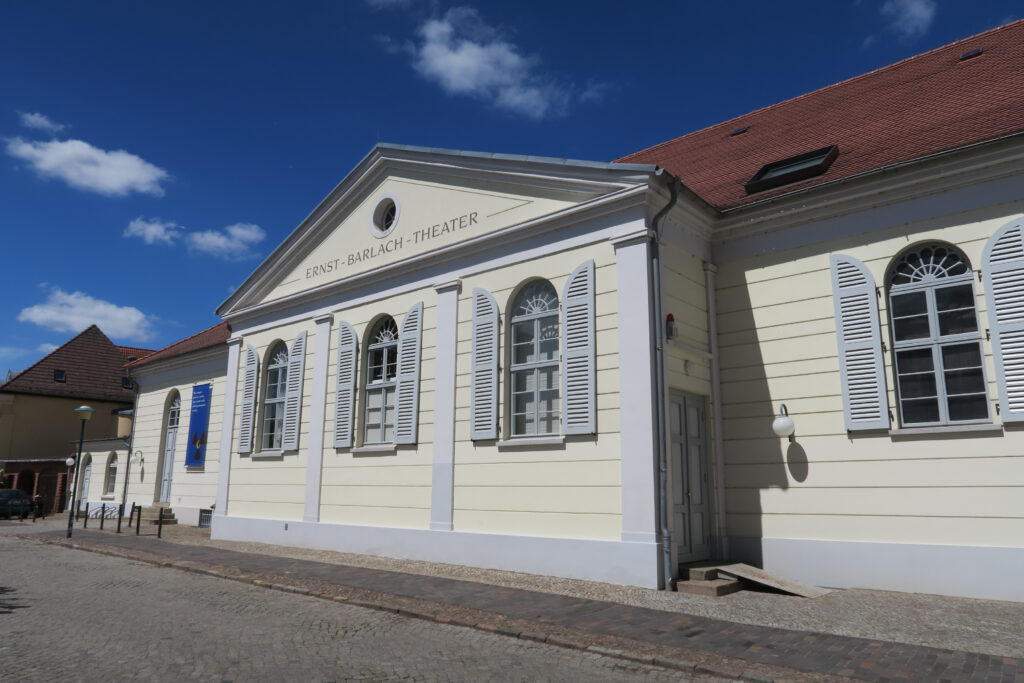
Mrs. Sandberg, when you were awarded the Theaterpreis des Bundes for the Ernst-Barlach-Theater Güstrow, you already knew what you intended to do with the prizemoney: employ a theater educator to strengthen cultural education and outreach. There are now, in fact, three of us in this Zoom interview; the theater educator Jazz Brantsch is sitting next to you.
Johanna Sandberg: Exactly. She has been here since mid-September, and we started offering theater courses immediately at the start of the season. It’s going great!
Mrs. Brantsch, you stepped in super fast. What path brought you to the Ernst-Barlach-Theater in Güstrow?
Jazz Brantsch: I am a trained actress and, after receiving my diploma, I first started working as a freelancer in film, television and theater. When I started teaching on the side, I realized that theater education is also an area that interests me a lot. So I also got a state-recognized BuT degree and then applied to theaters throughout Germany. The position in Güstrow particularly appealed to me because theater education is just starting up here, so I could contribute my ideas from the very beginning. When I got the offer, I spontaneously moved from Cologne to Güstrow.
What exactly do your theater education programs for the Ernst-Barlach-Theater look like?
Brantsch: We currently have two courses. The first one is our TheaterENTDECKER [Theater Explorer] course, which is directed at children and young adults between ten and 16 years of age and is about the absolute fundamentals such as stage presence, voice training, perception, but also the question: How do I behave in a theater? That I listen to others when they are on stage, or that I – not like in a movie theater – don’t eat and drink in the auditorium. At the same time, there is also a motto for this course. It is: “Truth is a matter of perspective”, because the participants train to take up different perspectives. This exercise can also be transferred to social contexts: You learn to comprehend why a person in a certain situation shows a certain reaction. And that is my objective: that we all widen our horizons a bit.
And what happens in the second course?
Brantsch: Our second program, the TheaterSPIELER [Theater Player], is understood to be a multigenerational course for people above 17. There I also work with biographical approaches and methods of Augusto Boal’s Forum Theater.
So a participative form of theater that seeks to create consciousness for social processes and enable people to actively contribute by playfully finding solutions for the problems being addressed.
Brantsch: Exactly. In terms of content, it’s about what moves Güstrow, what specifically drives the individual participants and what issues exist in the group. We create a play together from that material.
Sandberg: A thought that I always have in the back of my mind is that the Ernst-Barlach-Theater will be celebrating its 200th birthday in 2008. To mark this anniversary, I would like to present a program in which this town’s inhabitants bring their own concerns on stage.
What are the “concerns of the town’s inhabitants”?
Brantsch: For the younger ones, it is particularly the question: How can we find our voice? They are very aware and have many ideas, but they feel unheard in society – politically as well as generally. Theater can be very supportive here!
And what affects the participants in the multigenerational course?
Brantsch: For the adults, they each have more individual issues. A complex that many share is parenting – and, associated with that, their work-life balance. I have a lot of mothers in my course and always notice how much energy they expend to organize babysitters so they can attend regularly. They show me that the course is a place in which they can be creative and get to know themselves in a new way, as individuals but also together, in a protected space beyond daily life and obligations once a week. And because this space is so protected and we are also at the very beginning of the process, I really can’t be more concrete about the contents.
Is there something that particularly surprised you during your start in theater pedagogy at the Ernst-Barlach-Theater?
Brantsch: Yes, that so many people in a higher age bracket are interested in my course! I have several participants above 60, but even some above 70 – that is certainly not a given. Until now, I ’ve mostly known people in this age group to tend to withdraw. It think it’s great that they are going back on stage and trying something completely new!
Mrs. Sandberg, the residents of Güstrow show an above-average involvement in their theater. Decisive renovations such as new audience seating were realized due to private donations, for example. Is this high degree of identification with the house reflected in demand for the courses?
Sandberg: Definitely! We could theoretically offer far more courses, but it isn’t possible due to time and personnel constraints. This is why we have started by concentrating on these two courses. But we do have ideas to expand the offers. For example, we are in contact with a state training center located in Güstrow for children with hearing impairments. Its faculty reached out to me a while ago and was enthusiastic about the fact that we would be having a theater educator. Now we are developing ideas together for inclusive courses.
The Ernst-Barlach-Theater doesn’t operate with its own productions or its own ensemble; it’s a venue for guest performances. Is it still possible – or is it even a goal of yours? – to coordinate the theater pedagogic programs with the guest performances, or do the courses exist completely independently?
Sandberg: Up until now there weren’t any concrete touchpoints, but we observe that many course participants make plans to go to the theater together. I find it very nice, and we are thinking about expanding this. One idea, for example, is to initiate a kind of table of theater regulars that Ms. Brantsch would supervise and where you could watch performances together and then talk about them afterwards.
So, the theater education programs, which has generated such interest and demand, is actually financed by the one-time prizemoney of the Theaterpreis des Bundes. What is the perspective for the future? Do you see a possibility to maintain the theater education position and thus the program?
Sandberg: Of course, I definitely want to maintain it; that was my wish and goal from the very beginning! We hope to open up the hearts of politicians and administration by showing all people how important and wonderful this work is for the city and entire county – and we hope that I will succeed as the artistic director to acquire new funds for it.

During our last conversation you said that you are also fighting for renovation work, such as for the dilapidated cloakrooms. The associated application that the city and county submitted together was unfortunately not approved.
Sandberg: In general, we are – also thanks to the Theaterpreis des Bundes – on the right track. Both the town and county have agreed to lead the theater into the future together; currently, a new cooperation agreement between the two is being worked out in order to initiate the planning for a cloakroom building as well as a possible theater café. In this context, accessibility would be ensured; the budget for planning has been allocated.
Congratulations!
Sandberg: The Theaterpreis des Bundes really had a very positive impact, also in the political and administrative spheres. The audience has always known that the Ernst-Barlach-Theater is great. Now everyone else knows as well! (Laughs)