
Kathrin Mädler, artistic director of the Theater Oberhausen and winner of the Theaterpreis des Bundes in the Municipal and State Theaters category, in conversation with Christine Wahl
Ms. Mädler, congratulations on winning the Theaterpreis des Bundes in the category of Municipal and State Theaters – and to start things off, here’s a question we ask all award winners in the special categories in this interview series: If you had to symbolize your theater with a single prop, what would it be?
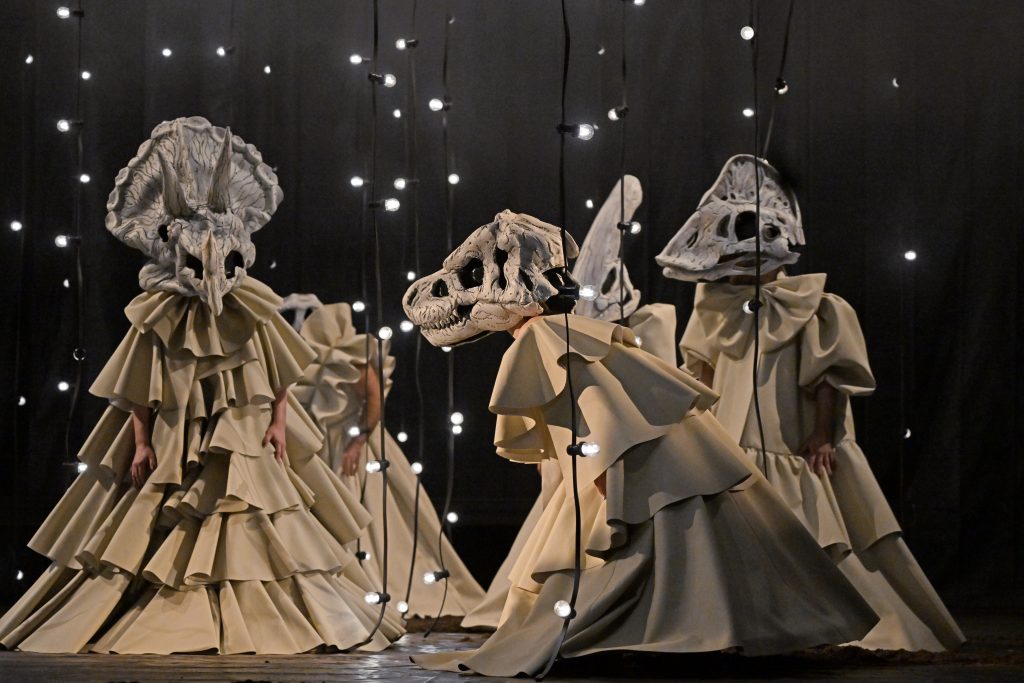
Kathrin Mädler: I wouldn’t symbolize our theater with a single prop, but rather with the props department: This small, agile, extremely imaginative, passionate, incredibly hardworking, yet extremely cool, approachable and always accommodating department epitomizes what characterizes all our departments.
As artistic director, you’ve now received this honor for the second time. Back in 2019, your previous theater – the Landestheater Schwaben in Memmingen – was among the award-winning theaters. Can you reveal your recipe for success?
Mädler (laughs): I think it’s not down to the management, but rather the team – and here in Oberhausen, just like in Memmingen, it’s absolutely fantastic! In fact, you have to be willing to think radically together about what role you want the theater to play in the city: What kind of space does this specific urban community need, and what kind of art is right for this place? And “radically” means that you have to question yourself self-critically and to focus on: What are we good at, what really interests us, what can we credibly represent – and what should we maybe no longer do? Because if you aren’t passionate about what you do, things end up half-baked, and then the audience won’t respond with passion either.
So, what would be an example of something you no longer do in Oberhausen?
Mädler: We – and by that I mean above all our fantastic dramaturgy team – have long since stopped saying: “We’re going to stage a Kleist or a Schiller or a Lessing,” just because we think, “We really ought to do a classic again!” Sure, “Prinz Friedrich von Homburg” is undoubtedly a fantastic play! But is it really what speaks to us now? I’ll honestly admit that I’m less and less interested in the canon, and I notice the same thing among my colleagues in our dramaturgy meetings: On average, there are at least three contemporary works on the table that captivate us more than the classics – even if we find a current connection there too. So, we’ve consistently opted for contemporary works and strictly agreed that for every production we include in the program, we must be absolutely 100 percent certain why it’s there.
You’re not only a proponent of contemporary theater, but also of a decidedly “emotional” theater. What exactly do you mean by that?
Mädler: I definitely want the theater to move me! Of course, that’s also a matter of personal taste, but I really don’t care for those “cool” evenings with unconventional forms of performance, where I always get the feeling that the theater maker actually knows better and stands hyper-confidently alongside the material, and perhaps even above the characters. I think my understanding of theater fits quite well with the local audience. It’s got a bit of a “no bullshit” vibe: of not being fooled by anyone. In Oberhausen, you don’t go to the theater just because you go to the theater; in Oberhausen, you go to the theater because you’re specifically interested in exactly what’s happening on stage that night.
What are the issues that are currently occupying most people?
Mädler: I think a large part of the population is actually extremely concerned with social issues. Oberhausen has a very high unemployment rate – and alarming levels of support for the far-right AfD. We’re actually a classic SPD stronghold with a Social Democratic mayor, but the AfD got 21.5 percent in the last local election and now holds 13 seats on the city council. That’s obviously a huge issue – and it raises the question of how to maintain social cohesion in such a challenged urban community. At the same time, I get the sense that people here are actually very good at exactly that: developing a vision for a dignified future together.
In what way?
Mädler: You can simply tell that the city has a huge amount of experience when it comes to transformation. The awareness of the need to constantly change is deeply ingrained here. That is also what moves me so much about Oberhausen and what, in my view, connects the city very closely to the theater. There is a great awareness of pain – of loss and of wounds. And at the same time, people are fighting hard to stay resilient. I find that pretty impressive. To embrace life with such a down-to-earth, rugged spirit – in the best sense of the word! And this is also a genuine driving force for the theater: Confronting the pains of the past and repeatedly working to heal the wounds.
In fact, you see the connection between the city and the theater as so close that your theater even employs special “city ambassadors.” What exactly do they do?
Mädler: These are people who, with their specific artistic disciplines – direction, performance, or music – go out into the city and then during mini-residencies at our theater develop projects based on the phenomena they encounter. When we first arrived here, we started this not only because we found it a wonderful way to get to know the city ourselves, but also because it allowed us to invite the various communities to join us. And it has indeed resulted not only in great projects but also in long-term working relationships.
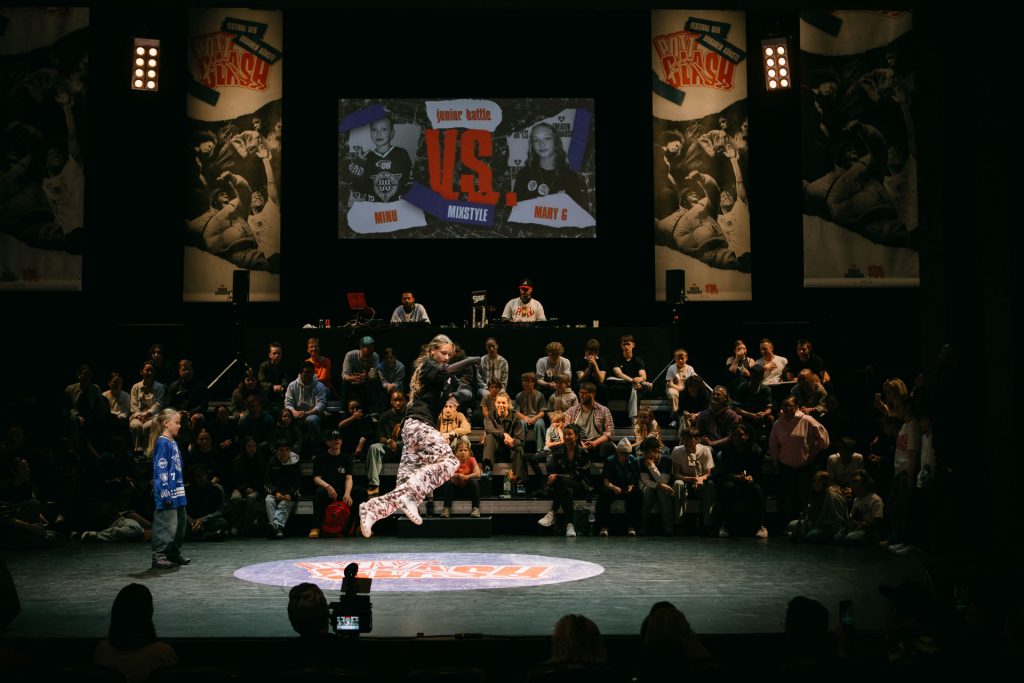
One community that is now firmly anchored at your theater – and is actually unique in Germany – is the krumping scene. Could you briefly outline what exactly this is for those unfamiliar with it?
Mädler (laughs): Krumping is a term from the urban dance scene: a very powerful dance language that emerged in African American communities in the US as a form of expressing resistance against social injustice. Thanks to the “Neue Wege” funding from the North Rhine-Westphalian state government, we were actually able to establish a new division for the 2023/24 season with six performers from this street dance movement, along with an artistic leadership team, and base it at our theater. While the urban arts scene is very vibrant and well-connected, it has been extremely underrepresented in cultural institutions until now. This division now stages its own productions and entire festivals at our theater, but is also active across disciplines and participates, for example, in the theater’s family play.
The Süd-Ost-Europa-Festival has also become a central part of your program.
Mädler: Yes, we were able to launch it in collaboration with the Goethe-Institut – and next year will be its third outing. Through this, we not only reach communities that are strongly represented in the city – Oberhausen, for example, has large Bosnian and Greek communities in addition to the Turkish one – but we are also bringing into focus questions about the future that are already the subject of much more intense debate in Southeastern Europe: Where do we actually want to go with Europe, what democratic values are we upholding, and what does freedom mean to us?
In fact, you once described your theater as a “theater of the future”.
Mädler: Yes, I believe that the future of theater can be examined particularly well here in Oberhausen because we’ve already dived much deeper into many questions that people in other regions are only just beginning to ask themselves tentatively. Recently, for example, I directed a production in Lübeck, a city with a tradition of an educated middle class and a long-established theater audience, where the auditorium is well-filled at every performance simply by the subscribers alone. In Oberhausen, you simply cannot rest on your laurels. Here, not only the city but also the theater in particular have already undergone an enormous number of transformation processes, and funds are so tight that the question of what purpose and function this kind of institution should serve for the city has long since taken on a completely different sense of urgency.
The Theaterpreis des Bundes in the category of Municipal and State Theaters is endowed with 100,000 euros. Which means more to you: the symbolic or the economic capital?
Mädler: Coming from Oberhausen, I have to say of course: The economic capital really cannot be underestimated; after all, the city is in one of the most financially disadvantaged regions in the country. However, it really should be noted here that with Apostolos Tsalastras as Head of Cultural Affairs and Treasurer, we in Oberhausen have hit the cultural policy jackpot! Although the municipality is facing budgetary constraints far more urgently than many other regions – and we are indeed all making sacrifices – there’s a clear commitment to the theater here and a deep understanding of the sense of community it fosters in the city. Given the precarious budget situation, we’re actually in a comparatively good financial position!
So, you’re opting for symbolic capital?
Mädler: I’m truly overjoyed for our theater that we have received this award! Colleagues from all disciplines and departments work here with a level of dedication, a sense of community and a lack of hierarchy that I’ve really never experienced before. And of course, this kind of recognition from the outside is wonderful! We’re all pretty good at reassuring each other that everything we do is great, but sometimes you do wonder: Is it just us who think what we’re doing here is good? The most important yardstick is and remains, of course, the audience, but naturally it’s a lovely feeling when someone else looks at our program from a more abstract perspective and can truly grasp what we’ve conceptually put into it. Still – just so there’s no misunderstanding (laughs): The money is great, too!
What are you planning to use it for?
Mädler: Since our lobby is currently a total construction site due to renovation and remodeling work, our set designer Franziska Isensee designed a container that’s now in the forecourt and that houses the box office, a bar, an atrium and even a rooftop beer garden. And this container is just so great that it has quickly become a regular gathering spot, attracting people from far beyond the neighborhood. That’s why we’d like to make it permanent, professionalize it and expand it into a new venue for performances and socializing. Oberhausen is in such desperate need of vibrant spaces – and I think the prize is a pretty good reason to implement that!