
Carena Schlewitt, the artistic director of HELLERAU – Europäisches Zentrum der Künste in Dresden and winner of the Theaterpreis des Bundes 2026 in conversation with Christine Wahl
Ms. Schlewitt, congratulations on winning the Theaterpreis des Bundes 2026! In an article about your theater, a member of the audience was quoted as saying: “If HELLERAU didn’t exist, I’d have left Dresden long ago.” What does she find at your theater that’s otherwise lacking in the city?
I think a major part of the appeal actually lies in the fact that our theater covers a wide range of genres. We don’t just show a variety of artists and companies – whether from the region, across Germany, or internationally. We’re also an interdisciplinary theater, and this versatility is further amplified across genres. Our music program alone ranges from sophisticated new music evenings to immersive sound installations and participatory formats, and I could say the same just as easily for dance or performance. In any case, at HELLERAU you always encounter a contemporary artistic language; you enter into a dialogue with the present.
Which is not something you necessarily find everywhere in a place like Dresden, a city that defines itself so strongly through its tradition when it comes to arts and culture?
Recently, a visitor came up to me and said: “When I have time off, I always go to HELLERAU. I don’t even check what’s on; I just hop on the train because I know I’ll always be surprised there.” I thought that was great, because that’s exactly the point for me: “I’m heading out there!” It’s doesn’t matter at all if I end up impressed every single time. But what I can experience here, I can’t experience anywhere else.
You’ll have to explain this “heading out there”!
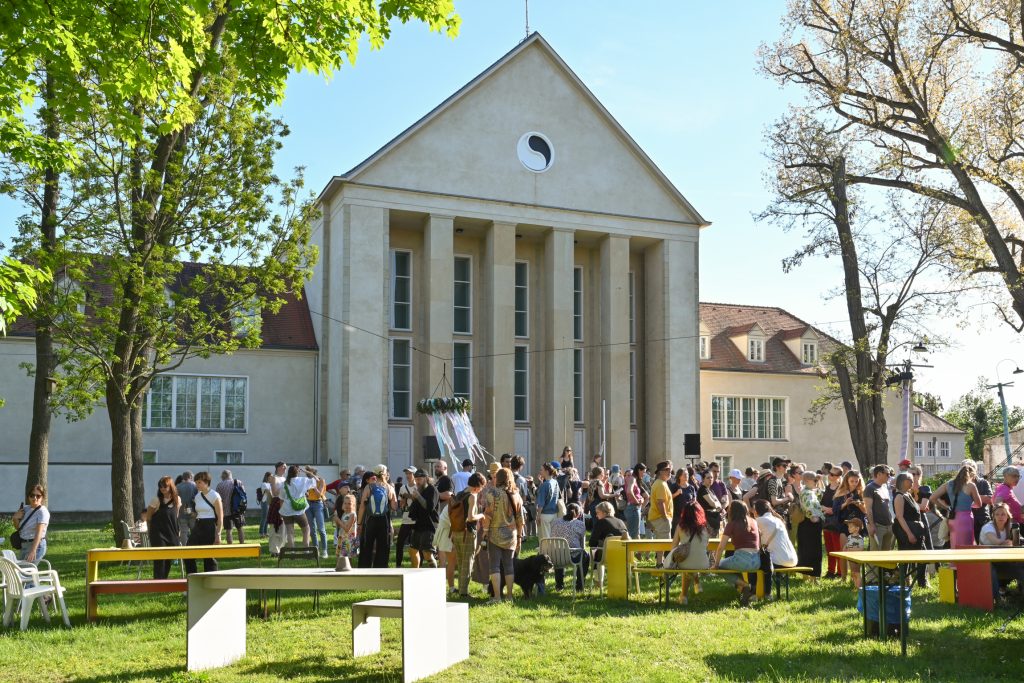
HELLERAU isn’t an urban location. It’s just under half an hour away from downtown Dresden; the Festspielhaus, [sd1.1]stands in the middle of a garden city – the first in Germany, built in the early 20th century by the carpenter, furniture manufacturer and social reformer Karl Schmidt based on the English model. The aim – absolutely revolutionary at the time – was a healthy triad of life, work and education. And no matter whether you come up the hill by tram, car, or bicycle: you always pass through a stretch of forest – and beyond it, there’s a completely different atmosphere. It smells different, it’s usually two degrees colder, the volume of sound changes; it’s almost like you cross a kind of threshold of perception.
A threshold that Franz Kafka, Max Reinhardt and Rainer Maria Rilke had already been fond of crossing.
Yes, in the 1910s – during the heyday of the Festspielhaus – they, like many other artists and writers, made a pilgrimage here! Hellerau was the epitome of avantgarde back then: the radically contemporary stage design that set designer Adolphe Appia and lighting artist Alexander von Salzmann had created in the great hall of Heinrich von Tessenow’s building stood in complete contrast to the typical Italian proscenium stage of the time. This was the first open-space stage in Europe; this abolition of the architectural separation between stage and auditorium had never been seen before – it was truly a monumental artistic experiment!
In fact, European and German history is condensed within the Festspielhaus Hellerau. It’s not only the glorious aesthetic modernism that has decisively shaped the place but also the barbaric Nazi dictatorship and East Germany’s communist system.
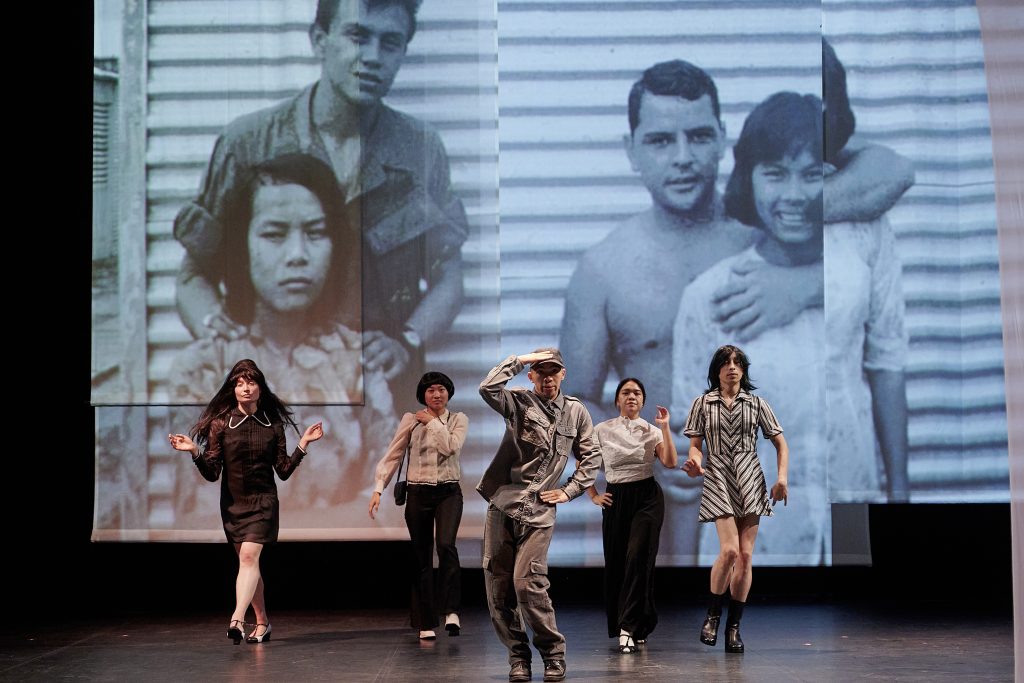
Yes, that’s absolutely shocking: For most of its history, which spans almost a century, the Festspielhaus Hellerau was used for military purposes! In 1938, the Nazis converted the Festspielhaus into a police training academy; later, they trained officers here for extermination operations carried out by the SS and the Wehrmacht, particularly in Eastern Europe. Then, in 1945, the Red Army arrived and used the site as a military hospital. Subsequently, Soviet soldiers were stationed in Hellerau, who also used the great hall as a gym – until 1992, when a group of dedicated cultural activists, with truly tireless tenacity, succeeded in reclaiming this location for the arts and culture. Of course, there were other plans for Hellerau back then as well. For example, there were plans to tear down the Festspielhaus and build something new instead. The international program we organize here seeks to shed light on all these different layers through an aesthetic lens. With the project, “Layers – Artistic Practices of Remembrance and Commemoration,” we have, for example, initiated a program series on topics related to “coming to terms with the past, passing on war traumas and silence in one’s own family narratives.”
In fact, you can experience everything of note in the international theater, dance, music and performance sectors at the theater. Since you’re also deeply committed to the local scene, your institution – as the largest independent production house in all of Eastern Germany – simultaneously plays a decisive role in regional artistic development. How do you actually manage all of this?
When I started at HELLERAU back in 2018, it was immediately clear to me: Given the local funding situation, we have to support the independent scene as best we can to help it gain greater visibility and secure strong co-production partners. The Kulturstiftung des Freistaates Sachsen does a truly excellent job, and other institutions in Dresden such as the Societaetstheater, the Zentralwerk, and the Villa Wigman are also enormously committed – that’s not the point. There is simply significantly less money here in the east than in many other regions. That’s why we co-produce projects by independent groups – often with minimal funding – in a targeted manner to at least somewhat cushion the difficult funding situation – especially since we’re exceptionally well-equipped in terms of space: Thanks to our residency apartments and rehearsal studios right on the premises, which are pretty unique, we have optimal working conditions. We’re now getting so many applications that – and this really gives me a massive headache – we often have to turn people down. And unfortunately, the number we have to turn down is growing, because HELLERAU’s public funding has been reduced significantly.
The theater is in a very strong position; visitor numbers have risen from around 26,000 in the 2023/24 season to just under 34,000 in the 2024/25 season. Nevertheless, at the end of 2024, the city’s cultural policy was forced, as part of general austerity measures, to reduce funding from 1.6 to 1.1 million euros. At the same time, the Bündnis internationaler Produktionshäuser lost its federal funding; HELLERAU had previously received 600,000 euros per year from that funding pool. With a shortfall of 1.1 million euros, your institution was suddenly – and through no fault of its own – faced with an existential threat. Since then, there has been a flood of kind words, and here and there a cosmetic adjustment to the figures. What’s the current situation?
Unfortunately, it hasn’t improved. In March 2025, a new budget resolution was passed that cushioned the impact of the city’s funding cut. Four weeks later, new cuts were imposed due to broader budget shortfalls. In the end we received a budget allocation, but now we’re back to a budget freeze. Operations and staff are secured for us as a theater of the state capital Dresden. The problem is that we have absolutely no planning security for our program. We’re now at 80 percent third-party funding.
That sounds dramatic.
I understand that when cuts have to be made everywhere, culture can’t remain untouched. What I’m critical of is the fact that people aren’t sitting down together and analyzing things: How far can we go without substantially jeopardizing the theater? How does this cut or that reduction specifically affect the program and the theater? What mechanisms are involved when applying for third-party funding? We usually need a certain amount of our own funding to be able to secure all the program funds we’ve always depended on anyway. If that’s called into question, we could find ourselves in a situation where we suddenly have to return third-party funds. These are the kinds of things that keep me awake at night.
Particularly as there are political factions that have long had other ideas about how to use the HELLERAU. The far-right AfD – the strongest force on the Dresden City Council since the last elections – recently surprised everyone with a plan to house the East German Deutsches Fernsehballett at HELLERAU…
…which had long been disbanded by that point (Laughter). Yes, there was also a suggestion to abolish the ensemble at HELLERAU, even though we’re a production house without an ensemble.
But seriously: How threatened are arts institutions when they can no longer be sure of backing from those politicians responsible for culture – regardless of which party?
In our case, fortunately, there are people across party lines who clearly state that HELLERAU is not going anywhere. In addition, the process of establishing an independent operating entity is now underway: we are to be transferred along with the Staatsoperette Dresden and the theater junge generation into an independent operating entity called “Städtische Bühnen,” with a shared administration and consolidated workshops. I believe this merger can strengthen us all, especially since we’ve been repeatedly assured that artistic autonomy, the artistic directorships and the profiles of the theaters will remain untouched. But generally, I do think a lot about how cultural funding is currently being re-assessed – even beyond budget constraints – and what structural changes might be on the horizon.
Because HELLERAU may be taking on an increasingly avantgarde character – not only due to its cutting-edge program, but unfortunately also because of its precarious financial situation?
Maybe we really do need to let go of certain notions – completely regardless of whether we think that’s right or not. In 2024, I was at the Tanzplattform in Kaohsiung, a huge cultural center in southern Taiwan. When I asked the manager how they finance the venue, he said that it was 60 percent rental income and 40 percent from their own program. Or our Central and Eastern European neighbors: A few weeks ago, we hosted the “Transformation Forever” festival, featuring artists who were the first ones to proudly build this free, independent cultural scene in the post-Soviet states back in the 1990s. For the time being, they are masters at writing EU grant proposals, but otherwise they harbor no illusions: “Independent arts? No prospects!” And that’s not pessimism, but simply a description of reality. I hope that the independent arts won’t be confined to private apartments again in the near future.
Now you’ve been awarded the Theaterpreis des Bundes, which comes with not only symbolic but also economic capital, specifically in the form of 200,000 euros.
The prize is a wonderful recognition for the theater, our entire team, all the artists and the audience – we’re absolutely thrilled! And when it comes to the financial side of things, there’s already a long wish list, though nothing has been finalized yet. But of course, the goal is to stabilize and further develop the theater.
What are your hopes for the future of HELLERAU?
That it remains a venue for the contemporary independent arts and internationality and doesn’t turn into a multiplex cinema. It’s really that simple.
More information about HELLERAU – Europäisches Zentrum der Künste