
Stefanie Heiner and Julia Heinrich, the directors of stellwerk junges theater in Weimar and winners of the Theaterpreis des Bundes in the Independent Production Houses category, in conversation with Christine Wahl
Ms. Heiner, Ms. Heinrich, congratulations on being awarded the Theaterpreis des Bundes in the category of Independent Production Houses – and to start things off, here’s a question we ask all award winners in the special categories in this interview series: If you had to symbolize your theater with a single prop, what would it be?
Julia Heinrich: A colorful palette – because we take great care to ensure that everyone feels seen and heard and is represented in all their facets.
Stefanie Heiner: A megaphone is the first thing that comes to mind: It’s important to us to give young people a voice – and a stage so they can make themselves heard.
Those who stand on this stage at the stellwerk junges theater in Weimar are, in fact, exclusively children and young people between the ages of four and 27 who perform in their free time. With this extraordinary cast, you’ve established – a first of its kind in Germany – a fully-fledged repertory theater. How do you organize everything behind the scenes?
Heinrich: We have a core team of five people – which expands to include freelancers for individual projects and courses. Of those employed here, two work full-time; unfortunately, due to our funding structure, we can’t afford more – even though there’s a need for everyone.
How do you manage to run a fully-fledged theater with this staff structure?
Heiner: We’re all multitaskers. For example, I mainly work as the theater’s artistic director – so I’m responsible for the program and direct the productions myself – but I often find myself spending the evenings first setting up the stage before the performance, then welcoming the performers, leading the warm-up with them, later handling the ushering, and perhaps even operating the technical equipment myself, such as doing the lights or sound. Sometimes I even lead the post-performance discussion and clean up. And it’s the exact same for Julia, as the theater’s managing director, and the rest of the team.
Heinrich: Ultimately, though, that’s also a major reason why our work is so fulfilling. We have extremely flat hierarchies; we all gain equally deep insights into every aspect of the theater, and that naturally gives us a whole new perspective on how the theater operates – and what the people who come here are really interested in.
Hats off to you! How do you finance your program?
Heinrich: We receive state and municipal funding for the venue and staff – which we’re very grateful for, because that’s not a given in Thuringia. Since we are recognized as a “cultural hub” – of which there are very few in our state – we receive grants from the Thuringian Ministry of Education. However, we don’t have our own production budget. For all the productions and projects that take place here, we have to raise third-party funding – which is a tough battle, especially since we want to pay the people who work here fairly. Precisely because – when we look at our own salaries – there still seems to be room for improvement in many places when it comes to acknowledging that responsible work for young people in the arts and culture sector doesn’t just happen on its own.
Yet your workload is huge!
Heiner: Yes, each season we put on six premieres, which then remain in the repertoire for at least a year, and we have a repertoire that covers many different genres, themes, and age groups – from adaptations of classics to family plays at Christmas to theater for the very youngest children. In addition, we offer various age-specific courses, ranging from inclusive dance classes to improv theater and children’s courses for ages six and up.
Does everyone have to audition or can anyone who wants to simply join any production?
Heiner: At the start of each season, we always organize a season opener where we announce all our projects, and everyone – really everyone – can sign up based on their interest, preferred themes and availability. Even if you’re completely new to us and have never been on stage before, that’s no obstacle to jumping right into the production project that interests you.
Do the performers choose the themes themselves?
Heinrich: Of course, we ask the young people who are involved with us what’s going on in their lives right now, what interests them and what they want to work on. To do this, we hold an annual performers’ retreat where we ask them specific questions. Another way we identify themes is when artists contact us and suggest concepts they’d like to perform with the young people. In addition, we also issue open calls: If a particular theme seems particularly urgent for the upcoming season, we actively seek out artists or collectives who’d like to work on it.
Heiner: That’s also a good way to get to know new artists, because supporting emerging talent in the field of directing is another area we’re committed to. Especially since it’s so exciting for young people when new perspectives and viewpoints are constantly emerging.
What kind of ideas did the young people contribute this season?
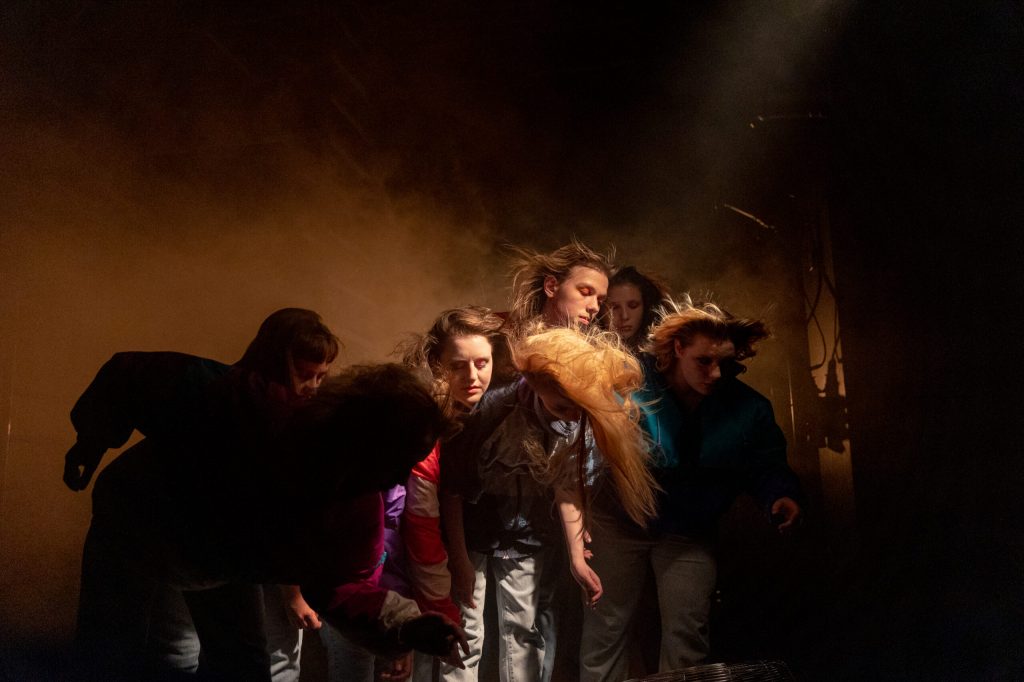
Heiner: One topic that emerged directly from the last performers’ retreat, for example, was the possibilities for protest in today’s society. Together with the Deutsches Nationaltheater Weimar, with whom we frequently collaborate on projects, we subsequently produced a musical theater production on the theme of resistance, spanning an historic arc all the way to the White Rose.
Weimar is located in Thuringia – a state that is, from the outside, primarily associated with the NSU, Björn Höcke, and the high level of support for the far-right AfD. What is your insiders’ view of your city and your state?
Heinrich: As a city of classics and a tourist destination, Weimar still has a bit of an “ideal world” image. That’s why we’re constantly trying to step outside our comfort zone, organizing guest performances in rural areas and deliberately addressing social issues. We also collaborate with partner schools from other regions.
What has really surprised you the most recently in your work with young people?
Heiner: It’s perhaps less of a surprise and more of an empirical correction of the image many older people have of young people – you know, this idea that the world has totally changed, that young people just hang around on their phones, don’t accomplish anything anymore, and so on. In contrast, every day I experience here just how smart these young people are, what clever things they say, and how quickly they grasp things without needing to have every single thing explained to them. They have a lot to say and are incredibly engaged – that’s absolutely fantastic!
Heinrich: I actually find it pretty crazy how much the world has changed – though in exactly the opposite way from what those people claim, who think that today’s youth can’t be trusted with anything. I’m totally impressed by the strength young people have developed to stand up for themselves and fight for different structures. That wasn’t the case 20 years ago.
You started your theater careers right here at stellwerk junges theater, didn’t you?
Heinrich: Yes, I came here when I was 18 to do a voluntary social year, and I still remember how small and shy I felt at first in this big theater world (laughs). Actually, I was toying with the idea of becoming a director back then and was able to try that out here, but I realized relatively quickly that it wasn’t my thing. Instead, I discovered the entire office world behind the scenes and realized: I want to do the accounting, planning, organizing events, and making sure everything runs smoothly – in short: cultural management is my thing! I did go away again to study, but I always remained loyal to the theater through part-time jobs and later as a board member. So, when the director’s position came up, I applied.
Ms. Heiner, do you also have a long history with the stellwerk?
Heiner: I do! When Julia was doing her voluntary year back then, I had just joined the theater fresh out of my studies as a theater educator. I worked at other institutions later on, for example, I ran a youth theater and a community theater. When the opportunity came along to take over the stellwerk together with Julia, I moved back to Weimar.
Heinrich: And now we’re absolutely thrilled to be able to do this dream job together! Among the staff, we often describe the atmosphere here as the absence of that “Sunday feeling.” That’s because we don’t have that typical Sunday mood people often talk about, where they have to go back to work the next day. On the contrary, on Monday morning we think: Hooray, here we go again!
You’ve now been honored in the Theaterpreis des Bundes in the Independent Production Houses category – and you’ve been awarded 100,000 euros. Do you already know how you’ll invest the prize money?
Heinrich: Well, first of all, when we got the news, we were completely blown away. I really had goosebumps for two or three hours straight because I couldn’t believe that something so important to me was also receiving this kind of attention and recognition from the outside world: It was literally too good to be true! And for our team, which brings so much initiative, passion, and heart and soul, this is like a knighthood, especially since we can’t exactly reward people with sky-high salaries.
Heiner: The fact that this work – which, after all, takes place here locally on a relatively small scale – is gaining greater visibility and receiving this kind of appreciation through this award is truly wonderful and very special for us! And as for the prize money: We will definitely continue on our path and work even harder to break down barriers. We might also treat ourselves to a larger-scale production with a bigger budget, where we can cast more artists than usual. Or we might even commission a play. That’s something we rarely do because usually we can’t really afford to pay the royalties.
Heinrich: And we can finally replace some technical equipment that’s broken down over the years! The team already has a long wish list (laughs).
What are your wider hopes for the future for your theater?
Heinrich: More visibility, especially beyond the region, and overall simply the long-term survival of the stellwerk – even if we eventually pass it on to others.
Heiner: I hope that for many years to come, many people will have the opportunity to develop alongside this theater and grow with it just as we have!