
Anna K. Becker and Katrin Hylla, the directors of the Schwankhalle Bremen and prize winners of the Theaterpreis des Bundes 2024, in a conversation with Christine Wahl about life after the award and investing the prize.
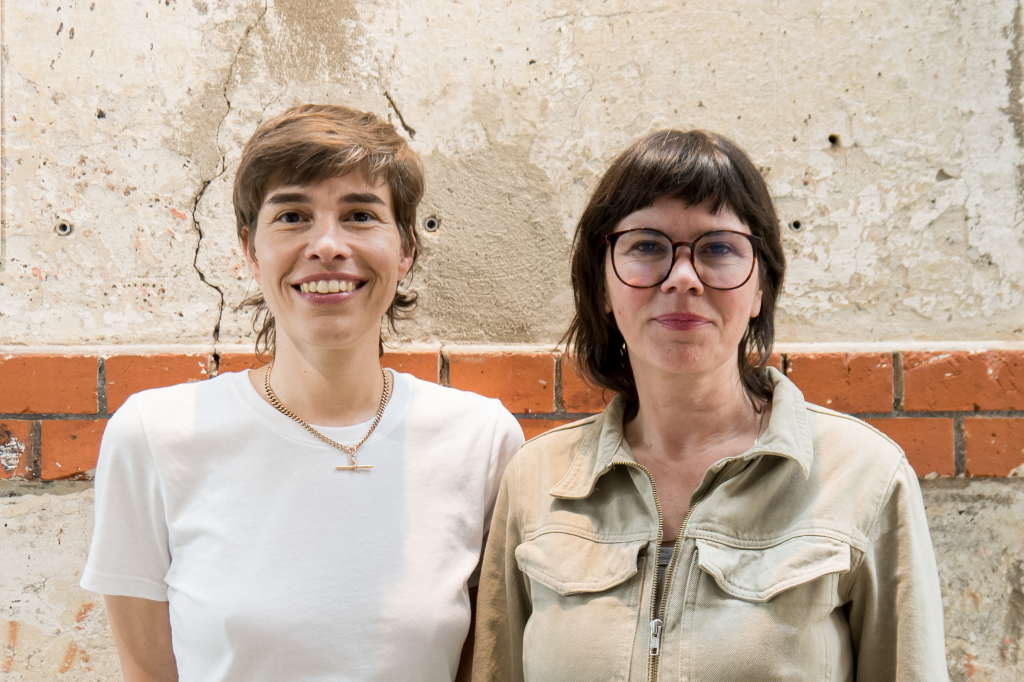
Frau Becker, Frau Hylla: in 2024, the Schwankhalle Bremen, which you direct, was awarded the Theaterpreis des Bundes. Besides the symbolic capital: How much of the 200,000 Euro that you received in prize money is still left?
Katrin Hylla: Plenty! Naturally, we were extremely happy about the prize, but we had already completely planned our 2024 and 2025 program so that we had to consider very precisely where we could sensibly invest the money at all.
So finally a luxury problem?
Hylla: The point is that the entire sum has to be spent by the middle of 2026. And as a small team with limited capacity, we’re not in the position to say: Hey, no worries, let’s just do one or two things more! So, we let ourselves be driven by the question: how we can invest the prize money sustainably? And I think we have found a couple of very good solutions.
And they are?
Hylla: One of our most important issues at the Schwankhalle is accessability, so a lack of barriers in every sense. We have had the wish to expand our expertise here for quite a while, to professionally educate ourselves further as a house and establish a few measures that we have already taken. Thanks to the prize money, we have taken a big step further here and were, for example, able to take part in the qualification program “Access Maker” from Un-Label.
It’s an organization that people from all of Europe with and without handicaps are involved in and advises cultural institutions in workshops, master classes and coachings on the subject of inclusion.
Anna K. Becker: The workshops and trainings by Un-Label are funded via the “Access Maker” program, but naturally you also have to pay an own portion. And if we cover all travel and boarding coasts, then you end up with quite a bit – especially because you sometimes have to reschedule something because there isn’t a single sign language interpreter available in the entire city. For us it was very good and correct that we were able to realize all of this optimally because of the prize money and, for example, didn’t have to think about whether we were going to take this or that technician with us to the trainings, but simply allowed all employees to participate, including the freelancers! By a stroke of luck, a further program will continue directly afterwards: “Vielfalt gestalten” by the Bundesverband Freie Darstellende Künste e.V.
Hylla: When we applied for the Theaterpreis des Bundes in 2024, another idea existed in reference to the potential winnings: We wanted to create a programming advisory board.
Because, as you said back then in an interview, it’s important to you that your own perspectives are constantly “stirred up” by other viewpoints and are then even directly included in program curation.
Hylla: Exactly. In this context, we were dealing with the questions of what perspectives should be represented in such a programming advisory board, of how we find the right people, how they can be paid for their work and what role they should have in programming work. In the context of “Vielfalt gestalten”, this plan is now becoming more concrete in the direction of a group of critical friends who guarantee that our learned knowledge is kept alive and constantly updated to take down barriers.
Becker: Razing barriers doesn’t simply mean that we are now offering two times as many audio descriptions per year, but instead, it has further-reaching consequences. For example, in the meantime there are fundamentally two evening shifts: one is at the “access table”, a contact point in the foyer where audience members can get all the information they want about the piece that they want to see.
Are you working on breaking down barriers in any additional areas?
Hylla: Right now we are in the process of including the Schwankhalle’s surroundings and reshaping the entire cultural site by consistently taking accessibility into account there as well: What do signs need to look like; how should the paths be designed? It’s about a long-term perspective and sustainable structures, even for the time after we have worked here.
Becker: It is truly invaluable that this prize money makes these investments possible, because dealing with access and razing barriers naturally also means that processes are slowed down. Fundamentally, more time and more resources are needed, in all imaginable directions. It already begins with gastronomy in the lobby: As a result of the workshop, we created a digital drink menu, for example, that will also be illustrated. Or there is a shuttle service from the tram station that can be ordered by phone. To do so, people need to be given the necessary time, and this is definitely something that we can only make possible due to the prize money.
Did some of the money flow into artistic projects?
Becker: Sure! When do you have your first evening shift for the living room concert, Katrin?
Hylla: Tomorrow, at two and at five.
What exactly is a “living room concert”?
Hylla: It is a format that we originally developed during the Corona pandemic and had adapted to contact limitations. Now, we are reactivating it for other conditions: We are getting into public transportation with a guitar and a cool costume and visiting people who can’t come to us, for example, because their mobility is limited or they are single parents. We then perform a half-hour concert in their living rooms.
A mobile cultural service – great!
Becker: Another example of the artistic use of the prize money is the performing arts festival OUTNOW! that we organize biannually together with the Theater Bremen. So we put together a special program for the next edition, in which discussions about questions of the future take place with visitors and experts in various exchange formats under the title “WHAT NOW?”: What should this kind of a festival look like in the future; what should it achieve? How can you demonstrate your solidarity instead of elbowing your way through? At the same time, we want the Bremen scene to be more included – for example, through a format that Katrin thought up: the long night of unfunded projects.
Where you draw attention to those ideas that couldn’t be realized because the relevant funding applications were rejected?
Hylla: Exactly. At the time when we were awarded the prize, budget cut announcements were being delivered to mailboxes everywhere. More than once, we were tempted to say: People, if you haven’t received any money from the cultural administrations, then we will finance your project! But in the end, it didn’t seem to us to be the right path, because if the will is lacking in cultural policy to support certain things, then those gaps need to be visible.
Did the Theaterpreis des Bundes, besides the investments we just discussed that the Schwankhalle was then able to make, go hand in hand with an increase of symbolic capital?
Becker: We were absolutely thrilled to receive the award, felt very honored and received many heartfelt congratulations from colleagues as well.
But above all, the movement towards opening up, which you were able to intensify due to the prize, will certainly also bear fruit with the audience?
Hylla: Most definitely! It’s precisely this opening that is needed – keyword: theaters as third places –to be able to afford niches in the long term and just do art for art’s sake! This balancing act is great and exactly right.
Becker: The reactions from our various audiences demonstrate it. Again and again, we notice that certain generations or communities suddenly believe in a piece, because they have been in a choir here before, for example. And because they know that they will be treated in a friendly way and that it is a place where it’s not about understanding everything right away, but where your try things.