
Artistic Director Stefan Hallmayer, Managing Director Christian Burmeister-van Dülmen, and Head of Public Relations Simone Haug from the Theater Lindenhof Melchingen – winner of Theaterpreis des Bundes in the category of Private Theaters & Theaters Hosting Guest Performances – in conversation with Christine Wahl
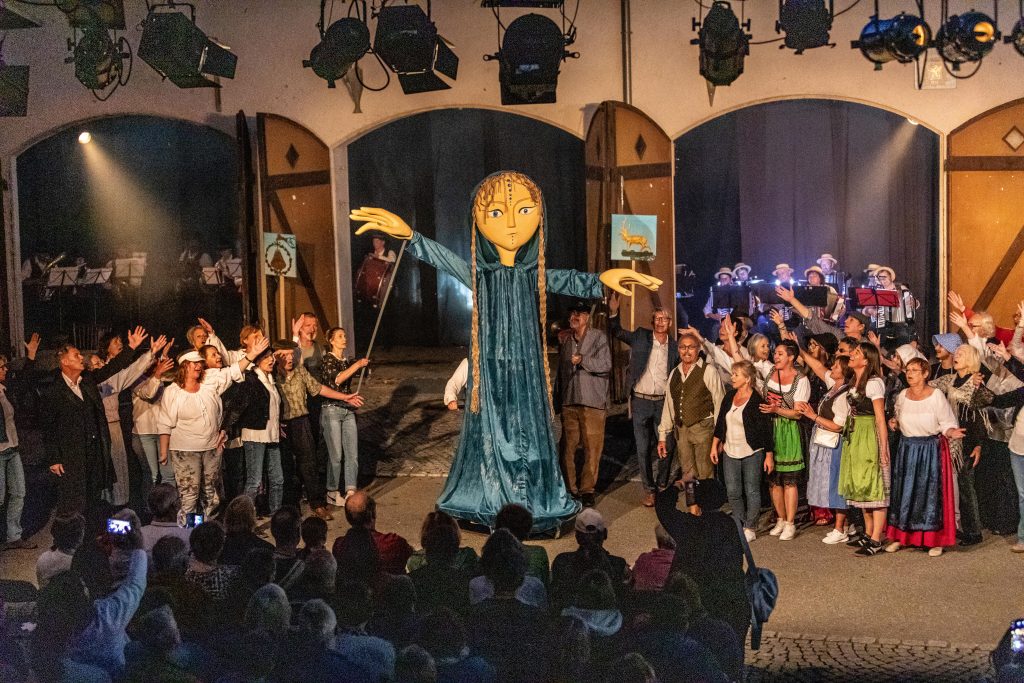
Mr. Hallmayer, Mr. Burmeister-van Dülmen, Ms. Haug, congratulations on winning the Theaterpreis des Bundes in the category Private Theaters & Theaters Hosting Guest Performances – and to start off, a question we ask all the award winners in the special categories in this interview series: If you had to symbolize your theater with a single prop – what would it be?
Stefan Hallmayer: A magic wand, because with it you can instantly jump into different worlds and eras.
Christian Burmeister-van Dülmen: For me, it would be an old stone. Here in the Swabian Alb, we have very stony and limestone-rich soil, and every time it rains, it looks as though these stones, which are also used to build houses in the region, are growing anew from the earth. To me, that perfectly fits the Theater Lindenhof.
Simone Haug: For me, too, it would be the stone. Not only because we are truly deeply rooted in this soil through the regional stories we present. But also, because our own path as a private theater has been quite rocky, and we ourselves can certainly rub people the wrong way: We aren’t always comfortable.
What kind of plays do you put on?
Hallmayer: When you start turning over the stones, you come across great theater stories! We find material that suits the region in the works of successful authors like Werner Schwab, Bertolt Brecht, or Franz Xaver Kroetz, but also in village archives or right in our own neighborhood. If we’ve gained one insight from the 45 years we’ve been around, it’s that world history also takes place in the so-called provinces. For example, we’re currently working on a play about a married couple in a neighboring village who were spies for the Russian government and were exposed when their unsuspecting daughter condemned the Russian attack on Ukraine at the breakfast table.
Mr. Hallmayer, how did you actually come up with the idea back in 1981 of setting up a theater in a former restaurant in the village of Melchingen of all places, together with other theater enthusiasts?
Hallmayer: If we’d all been better at accounting back then, we certainly wouldn’t have done it (laughs)! But our little troupe had already existed as a loose group before that; we’d rehearse sometimes in Tübingen, sometimes in Reutlingen, and then suddenly one of us had a bit of money, and the village restaurants were standing empty. So, we bought the Gasthaus Linde and met there once a week to build, cook and rehearse, though the theater actually only emerged as the core of the whole thing later on. Basically, it was a dropouts’ project: We didn’t want to do what our parents had in mind for us. Most of the founders of the “Lindenhof” were raised in rural areas, and the aim was to break free from those authoritarian, archaic, patriarchal structures. In the first play we performed, I played a woman: unthinkable for a villager back then!
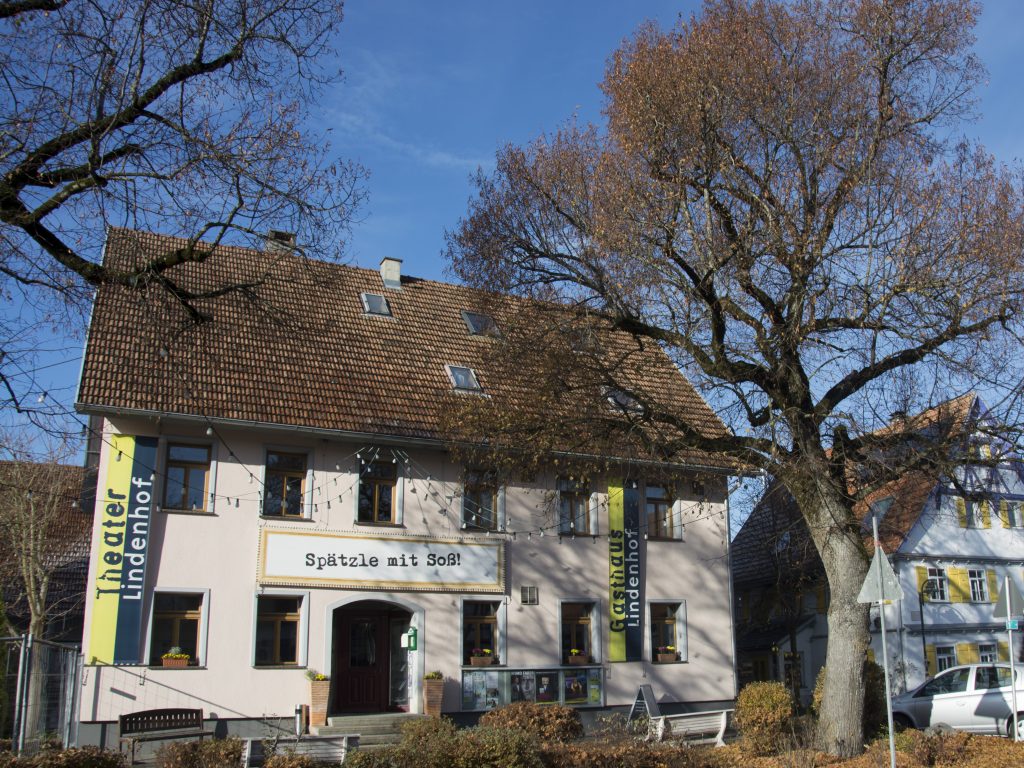
So, theater as self-empowerment?
Hallmayer: A lot of people back then said: They’re crazy; they’ll be gone again in two years at the latest! But theater-crazy and stubborn Swabians that we were, we stuck around and together we got the theater on its feet. The fact that it was in debt from the start only brought us closer together. We supported each other; parents and siblings helped with putting in the roof. And then we found success: People made the pilgrimage out here from Reutlingen, Tübingen and even Stuttgart.
In your bylaws, you describe your theater as “critical-poetic folk theater.” What exactly do you mean by that?
Haug: Terms like “folk theater” or “Heimat theater” are a bit tricky, but for us they embody the positive idea that theater is made for the people – and with the people – whose stories we tell. In any case, the term has nothing to do with folksiness: You won’t find any amusing peasant farces here. Our approach is more critical: We look for the friction points in society and shine a spotlight on them.
Hallmayer: Villages and rural areas are often described from the city’s perspective and associated with a sense of deficiency. And we resist the notion that the countryside is perceived solely as place that supplies city dwellers or where urban utopias are projected. I always say: regional theater for the world, world theater for the region – whereby we understand the latter in the Blochian sense: A sense of home arises where one is allowed to participate and help shape things democratically.
Which is actually possible in a very concrete way at your theater!
Hallmayer: Here, in addition to productions with our professional actors, we have in fact been practicing something from the very beginning that today is called “participation” – but this was long before the term even existed. We regularly have participatory formats: productions in which, for example, people with special needs or even prisoners take part. I firmly believe that these rather village-like traits of helping and supporting one another and tolerating differences are genetically inscribed in our theater. Even when people argue, in the end it’s essential for survival to get through the harvest and bring in the crops together; selfishness has to take a back seat.
Do you actually regularly rummage through the village archives – or how exactly do you find your material?
Haug: There are various ways. One, for example, involves our special partner-towns model: We have agreements with 20 towns to which we guarantee a regular theater program. Sometimes this leads to large-scale projects on the town’s history – though we retain full artistic freedom. Sometimes the town then ends up saying: Hmm, we were expecting something different! But they have to deal with that.
Burmeister-van Dülmen: Sometimes it really is a major negotiation process. In one of the Lindenhof Theater’s first partner-town projects – with Stetten am kalten Markt – the mayor was totally against it after reading the play. But the citizens involved, who of course also had support in the town council, insisted – and prevailed.
Hallmayer: We now hold a major summer theater project in Stetten am kalten Markt on an Olympics schedule – that is, every four years.
Burmeister-van Dülmen: Just like with the Oberammergau Passion Plays, people take time off work well in advance to participate and be there.
That sounds as if your projects are all absolute surefire hits – and you, as a public relations expert, are actually out of a job, Ms. Haug?
Haug (laughs): No, unfortunately that’s not the case. We really have to come up with creative solutions to get people up here. You can’t reach our theater by public transport during performance seasons. You might be able to get here without a car – but you definitely won’t be able to leave after the show. Mobility in rural areas is a major problem, which is why we now partner with a car-sharing service.
Burmeister-van Dülmen: On top of that, we naturally face stiff competition from two state theaters in the immediate vicinity – in Tübingen and Esslingen. Their explicit mission is to go out into the countryside and perform there; that’s what their funding is for. Touring is also a major pillar of our operation, and we do receive some funding, of course, but it remains a challenge nonetheless.
In fact, in addition to public funding from the state, district and municipality, as well as contractually-guaranteed contributions from partner municipalities, you have to generate considerable revenue on your own and are taking creative approaches to do so. For example, your box office doubles as a tourist information office, and your cloakroom serves as a hair salon during the day.
Haug: A few years ago, prompted by the Kulturstiftung des Bundes’ funding program “TRAFO – Models for Culture in Transformation,” we had a rethink about how our theater operates. The town lacked a tourist information office, even though a major cycling route runs right past the Lindenhof. So, we entered into a partnership with the municipalities and have since been offering hiking and biking maps at our ticket office.
Burmeister-van Dülmen: The hair salon also came to our building as part of this project. There isn’t another one in Melchingen, so the service is quite popular. We simply thought: Why shouldn’t spaces we only need in the evenings be used for other purposes during the day? First, it’s sustainable; second, it creates a wonderful intersection between art and society; and third, it also adds value for us: Maybe someone who gets their hair cut here during the day will also become curious about attending a theater performance in the evening?
The award from the Theaterpreis des Bundes in the category Private Theaters & Theaters Hosting Guest Performances comes with prize money of 100,000 euros. What is actually more important to you: the symbolic or the economic capital?
Hallmayer: Both. When you’ve been doing theater for 45 years, there are many times when you ask yourself: Why on earth did I start this? I’m 65 now and sometimes I think I’ve used up all my energy for reconciliation – I can’t go on. But then suddenly you’re performing somewhere in front of a delighted audience – or even win an award – and then you know: It was worth it!
Do you already have plans for how you’ll use the prize money?
Burmeister-van Dülmen: We want to implement an interdisciplinary theater project in a hall over 100 meters long – an industrial monument that is to become a sound workshop and explore craftsmanship from various perspectives.
Haug: Namely, both philosophical and tangible: Craftspeople from six different professions will be on stage there together with our actors and a community ensemble.
Hallmayer: Apart from the fact that, in the context of craftsmanship, many topics can be addressed that are currently on our minds – from the service society to digitalization – this is also a good way to get people into the theater who might not otherwise go very often.
Mr. Hallmayer, as the last founding member of the Lindenhof Theater, you’re retiring at the end of the season. What advice would you give to your successors as artistic directors, Sophie Miller and Nora Haakh, and to young theater professionals in general?
Hallmayer: That it’s worth fighting for the arts, because you can make a difference – even if the prospect of significant financial rewards is slim. And that it’s not just about asking, “Where is the stage where I can perform?” but about constantly creating new spaces for performance yourself.